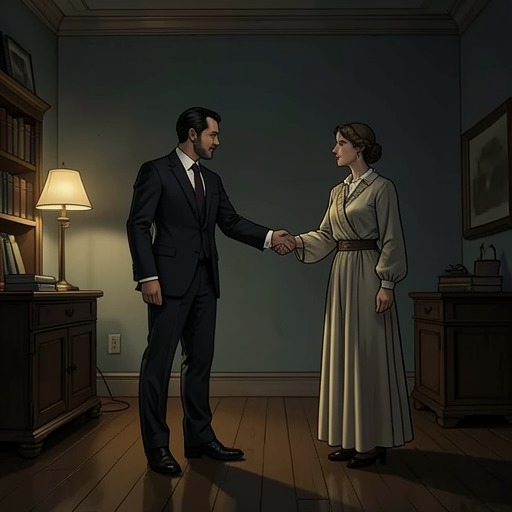
James Lechdale Fanthorp
Death on the NileJames Lechdale Fanthorp is a lawyer aboard the Karnak whose quiet presentation as a holidaymaker masks a family-commissioned inquiry into Andrew Pennington. His place in the plot is defined by this double position: he is both an observer of events around the murder investigation and a discreet investigator of Linnet Doyle’s financial affairs.
Identity and Background
Fanthorp gives his full name as James Lechdale Fanthorp and identifies himself as a lawyer. He lives at Glasmore House, Market Donnington, Northamptonshire, and says he is visiting Egypt for pleasure. His hesitation when asked why he has come makes that explanation seem incomplete; he later discloses that he has a specific reason for being there.
His uncle, William Carmichael, is Linnet Doyle’s English solicitor and has handled many of her affairs. Carmichael sends Fanthorp because his correspondence with Andrew Pennington, Linnet’s American trustee, and several incidents have made him suspicious that matters are not as they should be. Fanthorp’s assignment is thus an inquiry into a trusted financial representative, not simply a personal visit or an ordinary holiday.
Aboard the Karnak
When Hercule Poirot asks about his movements on the night under investigation, Fanthorp says that he went straight to bed shortly after half past twelve. His cabin, number 22, is on the starboard side, nearest the saloon. The detail matters to the inquiry into what passengers might have heard: Fanthorp says he knows of no one who heard the shot apart from the Nubian boy.
Fanthorp also discusses the conditions that could have muted the sound. The windows in the room were closed, the swing doors were shut, and he recalls that Miss Van Schuyler had felt a draught earlier in the evening. In those circumstances, he considers it possible that a shot would have sounded only like a cork popping. His account supplies Poirot and Colonel Race with practical information about audibility, although it does not establish exactly what every passenger heard.
The Shooting and the Inquiry
At one tense moment, Simon Doyle addresses Fanthorp in a faint voice, saying that someone is coming and asking him to present what has happened as an accident so that there will be no scandal. This appeal places Fanthorp close to the immediate aftermath of the shooting and shows Simon seeking his help in shaping how the incident will be understood. The available account does not establish whether Fanthorp followed the request.
Later, Poirot confronts the group with the sequence of murders aboard the boat and identifies Andrew Pennington’s revolver as the weapon used in the death of Salome Otterbourne. He tells Fanthorp that he has a duty to disclose what he knows. Fanthorp then explains Carmichael’s suspicions and the reason for his presence. The exchange brings his concealed investigation into the open, while also distinguishing suspicion from proof: the concern about Pennington is acknowledged as conjecture, not itself evidence.
Narrative Role and Limits of the Evidence
Fanthorp connects two lines of inquiry that might otherwise seem separate: what happened around the shooting and whether Pennington’s conduct in managing Linnet Doyle’s affairs warrants scrutiny. His testimony about the cabin, closed windows, doors, and possible sound of a shot gives the investigators concrete circumstances to assess; his account of Carmichael’s concerns supplies a reason for his otherwise puzzling visit.
He is not shown reaching a final judgment about Pennington, and the evidence provided does not settle the outcome of his investigation or explain what he did after Simon’s appeal. Instead, Fanthorp’s importance lies in the contrast between his outwardly unremarkable role as a travelling lawyer and the undisclosed purpose that brought him aboard the Karnak. His information helps widen the investigation, but it remains for Poirot to determine what suspicion can establish and what the evidence actually proves.